Thursday, December 20, 2012

The Lada Niva Toolkit (in English!)


Since our Lada Niva came minus the factory toolkit, and Lada can suffer from “intermittent running issues” we have been keen to either track down a replacement or build one from selections at Princess Auto (Harbor Freight to USA, Clarke to UK etc). After searching for a tool listing around the various internet resources I found lots of pictures of the toolkit but none of them had an actual list. However, after searching for one specific part number (12mm Allen wrench) I came across a manual that had the parts list… in Hungarian. Harnessing the power of Google Translate and a bit of logic I have been able to draft the following reference list.


12 – Ignition Adjustment Key
39 – Pressure Gauge, (Tires and Fuel)
41 – Fuel Hose
13 – Work Light 12V
43 – Bulb 21W (Work Light)

36 – Starter Handle
17 – Wrench, Open Ended 8mm & 10mm
22 – Wrench, Open Ended 13mm & 17mm
24 – Allen Key 12mm
25 – Wheel Wrench 19mm

28 – Socket, 8mm & 10mm
26 – Socket, 13/16 (Sparkplug)
27 – Punch, 8mm diameter X 150mm long (Socket Handle)
31 – Tire Lever/Iron
29 – Combined Screwdriver (Flat & Phillips)

32 – Tool Bag
30 – Pliers, Slip-Joint
23 – Wrench, Open Ended 22mm & 24mm
16 – Wrench, Open Ended 17mm & 19mm
19 – Wrench, Offset Box Ended 17mm & 19mm

18 – Wrench, Offset Box Ended 12mm & 13mm
37 – Jack, with Handle
42 – Hand Tire Pump
38 – Strap, Rubber (For Securing Jack)
10 – Strap, Rubber (For Securing Tool Kit)
11 – Strap, Rubber (For Securing Spare Tire)

Wednesday, December 19, 2012

The 1993 Lada Niva - тэ охоты (The Hunt)


How did we come to find ourselves (the staff at GTC that is) tangled up with a cold war relic, a Soviet “People’s Car” if you will?

It all stemmed from my interest obtaining a cheap, knockaround 4x4 to conduct “overlanding” excursions, and my fascination in Russian things. This, coupled with Shawn’s ingrained off-road nature and a watchful eye on the local Kijiji listings from Robb all brought us to the day we found a Lada.

In early November, Robb found a Kijiji listing for a $500 Niva and provided the urging to “go for it”. I had already asked Shawn his opinion (on Ladas) as he would be providing his years of off-road expertise and would be the muscle behind keeping something like this ticking. This Lada seemed pretty good, low price, which is always important for an experiment like this, decent mileage, 60,000 km’s, and by the photographs,  good shape-great shape by Lada standard.


So it was just a matter of landing this one. On Thursday November 8th,  I called the number listed and got a rather irate woman who was tired of people calling about a car she wasn’t selling, the listed number was incorrect. Giving it a bit of thought, I decided to check Kijiji for any other listings by the same seller, and I found a set of tires with a different number then tried that with success, I had gotten through!


The advert listed the Lada as having a broken engine mount and I asked the seller if it was drivable, (with caution) and he was adamant that a trailer would be required for transport. I said I would call back in a few minutes after I looked into trailering options. I called Shawn, explained the issue and he figured we could either chain the engine into place for a short run, or simply pull it with my SVT Lightning pickup with a U-haul. Invigorated, I again called the seller and asked if we could take a look that evening, and possibly purchase. Directions were given to a spot in Leduc AB, and we set off with cash in hand.


Due to bad weather it took a little longer than anticipated to make the trip to Leduc and we arrived under full darkness around 9pm. We gave the Lada a good look over, signed a bill of sale, and money changed hands. With the keys and the bill in hand we departed back north, planning to return on the weekend a few days later for recovery.

Sunday, November 18, 2012

Back in the Driver's Seat. (My own!)

When I last posted, it was over a year ago, I had just bid farewell to the Pontiac GTP (#2) and welcomed the replacement 2011 Ford Mustang GT as the wife's daily driver, and the "off-season" for dry pavement performance was just drawing to a close.


Since then I have transitioned from the role as a forum administrator over at www.mustangcanada.com (October 2011) to do some work with the Calgary based Fast Fords project (until August 2012) and when I gave my newly formed article archive a review, I was surprised to discover that I had nearly 200 separate works. Prior to Summer 2012 all of these individual pieces were only posted to somewhat unstable web forums, I had kept no formal backup or hard copy, so I made a serious change there. As I develop the time and space to do so, everything possible will be posted on a stable and permanent home on the internet, so stay tuned for that.

In the mean time I have been timelining everything on Facebook under the Grand Touring Concepts page located here: http://www.facebook.com/pages/Grand-Touring-Concepts/207098895986212 Perhaps drop in and take a look around, I am pretty impressed when I look back at all the stuff we've collectively accomplished in that tiny 440 square foot shop, and am working hard to share those memories with anyone interested.

The SS&S youtube channel has been a bit dormant, aside from some basic edit drag videos from the 2012 racing season at Castrol Raceway.

Ongoing projects to keep an eye out for are:

 Jesse's 1994 Mustang GT build: 
Equipped with only some junkyard GT40P cylinder heads and a Chinese intake manifold we were able to scoot this "Yellow Bastard" from low 14's into the 13.5 range. At the close of the season Jesse's tired, high mileage 5.0L Windsor engine developed some running issues that could be as minor as a head gasket issue or much more serious. More updates as that unfolds.


Shawn's 1993 Lada Niva project:
The first incursion into the foreign market cars, we've procured a $500 Lada Niva in need of some work. We will be making it trail ready and seeing what this old Russian SUV can do in Shawn's capable hands.


There is always something ongoing or in the works and I'll do my best to keep the updates coming!

Monday, September 26, 2011

Looks Good on Paper & NO LONGER Living with a Pontiac!

At a final odometer reading of 196,000kms (121,739 Miles) we are finally done with this 2003 Pontiac GTP. I wish I could give it a teary-eyed send off with platitudes like; “We’ll miss it so much” but in reality we’ll never forget this car, not because it was an unforgettable vehicle, but because it was so terrible.

Since the last update made on December 7th, things have not been smooth sailing for the GTP. The replacement fuel injector did cure the driveability issue and returned the fuel economy to normal but other problems cropped up over the spring and summer. More electrical problems.

The heater fan burning out it’s bearings is kind of a wear and tear item, but given the mileage I don’t believe it is reasonable to expect to need to replace that part so soon, at least compared to other vehicles we’ve owned. I know from “the Black Car” our previous 2002 GTP, that the cowl appears to drain water back into the fan which causes rust and early failure, I seem to recall a replacement part cost of $130 or so and a few hours under the dash for installation.

Another interesting puzzle to solve had to do with the ignition key and the park interlock. At times the ignition would refuse to release the key, usually when you were in a hurry to be somewhere. I scoured the internet for some insight about this condition and found that this is a very common problem for the W-body and other GM vehicles. The popular suggested fix is to disassemble the center console of the car then to inspect and repair two tiny connectors which break off the Park position sensor. When this harness is damaged the car apparently believes that it is not yet in Park and will not release the key. Armed with this knowledge I spent and evening working not to damage the brittle interior plastics and remedy the issue. However once I inspected the harness it appeared as new and undamaged. Some basic work with a volt-meter found no faults so I cleaned all of the connections with some spray cleaner and did reassembly.

The problem was now gone, however the Brake pedal shift interlock was now somehow broken. The car would allow movement of the shifter from Park without depressing the brake pedal. This is a minor safety issue which must have been caused by tinkering with the harness in the console, I left it alone and a few days later the problem cured itself, the shift interlock was restored.

Ever since Fall of 2010 we had been trying to keep this car running for minimal amounts of money pending a plan to trade in Summer or Fall of 2011. Normally I do not hesitate to buy part and properly fix things as required, but since the Canadian Book Value of even a pristine 2003 Pontiac GTP had fallen to basement levels, (At 196K mileage $3,000 Tops) any further money invested would soon result in negative equity when it came time to trade or sell. Mechanically and structurally the car was solid, however it was an electrical basketcase. This negative equity was something we were especially afraid of should something like a transmission fail, a legitimate concern based off of other owner’s experiences, $2500 and the down time would simply be unacceptable.

After finishing up our summer travelling we really set down to find a replacement for this car, lots of options had been discussed and finally we settled on looking for a gently used example of a 2011 Mustang GT.

There were a number of reasons on selecting the Ford Mustang.

It really seems counter-intuitive that a Pony car is a good idea for a daily commuter, but the Mustang is a solid value purchase. I personally have two and despite one being from 1995, it’s only required a new distributer and maintenance items to keep running smoothly. I’ve changed a great deal of parts on that car in the pursuit of higher performance and suffered subsequent breakages, but discounting “self-inflicted” failures, it’s been great. Parts are commonly available for nearly any Mustang built since Job 1 1964, either OEM or performance upgrades, low cost also makes things quite attractive. There is something to be said for the ease of driveline repair and maintenance of a conventional Front Engine, Rear Drive setup too.

All that said we began searching at the start of the summer very tentatively and last weekend we found a very suitable car. After driving for over an hour to a small dealership in Olds, Alberta, we were rewarded with a fair deal on our trade (given the market value, 5.5% of its 2003 original MSRP) and were finally into a replacement car.

A 2011 Mustang GT, 5.0L automatic with a cloth convertible top, well appointed and in great condition. Equipped with the new 5.0L engine and 6 speed automatic transmission, it also exceeded the best ever fuel economy of the GTP on the first highway outing. All this comes with more options, higher curb weight, a V8, and an additional 172 horsepower, simply a matter of technology marching onwards. Considering all of this, the Mustang should make a fine replacement of long-term daily driver for the wife, and be fairly cost-effective at the same time.

As a final parting shot at the Pontiac, at the very least Ford installed heated seats for both front occupants and not just the driver like the GTP offered…

It’s been quite an adventure with this GTP, both of us are relieved to see it gone, and if you see a Silver GTP cross your local auction block, consider this a fair and friendly warning of what to expect. At least the fuel gauge is always full…

Closing Stats on the outgoing GTP

2003 Pontiac Grand Prix GTP

Date of Purchase: August 2007
Date of Trade: September 2011

Mileage on Purchase: ~90,000km
Mileage at Sale: 196,000km
Value Depreciation since purchase: 8.5 cents per KM

Performance: 240 HP & 280 TQ
0-60 MPH: 6.6 seconds
¼ Mile: 15.9 seconds at Castrol Raceway

MFG Recalls: 1 – Engine Compartment Fire

Average US MPG: 22.3
Best Reported US MPG: 27.5
Average Fuel Cost: 13 cents/km (Premium Fuel Required)

Vehicle Breakages, Deficiencies, and Maintenance during ownership:

Powertrain:
Cracked Thermostat Housing
Replace Intake Manifold Gaskets
Oil Pan Gasket leak
Transmission Pan Gasket leak
1 Faulty Fuel Injector
Spark Plug Wires
Spark Plugs
11 Sythetic Oil Changes

Chassis & Suspension:
Replace Brake Pads
Replace Tires
1 Wheel bearing/ABS Sensor
Inner wheel housing liner collapsed


Interior & Electrical:
Onstar System Inoperative due to outdated analog hardware
Fuel Level Sender Defective
6 Headlight bulbs
5 Foglamp Bulbs
Defective Park Interlock switch
Defective Stereo/Clock display
Replace Windshield washer pump
Defective Heater Fan
Defective HVAC Fan Controller
Broken Interior Trim & Heated Seat switch
4 Burned out gauge cluster lamps
Cracked & Brittle weatherstripping

Read the Entire Living with a Pontiac Series:

Looks Good on Paper:

UPDATE 1 –

UPDATE 2 –

Back in the Grind - Looks Good on Paper & Living with a Pontiac

Friday, April 15, 2011

Factory Stock Mustang ¼ mile Test Times

As compiled from online sources & magazine tests. (Updated 16 Jan 2013)

Fastest to Slowest

11 Second Range

2013 Ford Mustang Shelby GT500 - 11.25 @ 127.9 MPH (SVTP Forum)
2010 Ford Mustang Shelby GT500 - 11.951 (MM&FF Oct '09)

12 Second Range

2011 Ford Mustang Shelby GT500 - 12.0 (MM&FF Oct '10)

2007 Ford Mustang Shelby GT500 – 12.257 (MM&FF Aug '06)

2011 Ford Mustang Boss 302 - 12.3
2011 Ford Mustang Shelby GT500 - 12.35

2003 Ford Mustang SVT Cobra - 12.4
2008 Ford Mustang Roush 427R (Auto) - 12.44 (MM&FF May '08)

2006 Ford Mustang Roush Stage 3 -12.63 (MM&FF Nov '10)
2011 Ford Mustang GT - 12.67 (Dragtimes)
2003 Ford Mustang Roush Stage 3 - 12.67 (MM&FF Apr '03)
2005 Saleen SC281 - 12.676 (Dragtimes)

2011 Ford Mustang GT (Auto) - 12.73 (Dragtimes)

2000 Ford Mustang SVT Cobra R - 12.88 (Dragtimes)

2001 Ford Mustang Roush Stage 3 - 12.9
2007 Ford Mustang Shelby GT500 Convertible - 12.9

13 Second Range

2010 Ford Mustang Roush 427R - 13.1
2003 Ford Mustang Mach 1 (5 Speed) - 13.15 (MM&FF Oct '03)

2001 Ford Mustang SVT Cobra - 13.34 (MM&FF Sep '01)

2005 Mustang GT – Manual – 13.5
2010 Mustang GT - 13.5

1969 Ford Mustang Boss 429 - 13.6
2007 Ford Mustang Shelby GT - 13.6

1995 Ford Mustang SVT Cobra R - 13.67

2008 Ford Mustang Bullitt - 13.7
2011 Ford Mustang 3.7L V6 – 13.7

1971 Ford Mustang Boss 351 - 13.8
2005 Ford Mustang GT Convertible - 13.8
1969 Ford Mustang Shelby GT500 - 13.87
2003 Ford Mustang Mach 1 (Auto) - 13.88

1969 Ford Mustang Mach 1 - 13.9
1999 Ford Mustang SVT Cobra - 13.9
2007 Ford Mustang Shelby GT-H - 13.9

14 Second Range

1994 Ford Mustang SVT Cobra - 14.0
1996 Ford Mustang SVT Cobra - 14.0
1998 Ford Mustang SVT Cobra - 14.0

2001 Ford Mustang Bullitt GT - 14.1
1999 Ford Mustang GT - 14.1

1987 Ford Mustang GT - 14.4

1993 Ford Mustang SVT Cobra - 14.5

1989 Ford Mustang GT - 14.8
1992 Ford Mustang LX 5.0 - 14.8

1970 Ford Mustang Boss 302 - 14.9
1985 Ford Mustang GT - 14.9
1990 Ford Mustang LX 5.0 - 14.9
1994 Ford Mustang GT - 14.9

15 Second Range

1988 Ford Mustang GT - 15.0
1998 Ford Mustang GT - 15.04 (Dragtimes)

2005 Ford Mustang V6 - 15.3

1967 Ford Mustang (390ci V8 w/4spd) - 15.6
1991 Ford Mustang GT - 15.6

1964 Ford Mustang (289ci V8 w/4spd) - 15.7

1984 Ford Mustang SVO - 15.8

16 Second Range

1993 Ford Mustang GT (auto) - 16.1

1973 Ford Mustang 351ci - 16.3

1999 Ford Mustang Convertible V6 - 16.5

17 Second Range

1981 Ford Mustang M81 McLaren (2.3L Turbo) - 17.3
1995 Ford Mustang V6 - 17.3

1975 Ford Mustang II (302ci V8 Auto) - 17.5

1977 Ford Mustang II 302ci - 17.7

1966 Ford Mustang (289ci  Auto) - 17.9

18 Second Range

1980 Ford Mustang Cobra (255ci) - 18.4

1980 Ford Mustang (255ci) - 18.5

1974 Ford Mustang II 4sp - 18.8

19 Second Range

1974 Ford Mustang II 2.3L Auto - 19.4

Know of a faster time? Link it in the comments section and I'll post it in.

Saturday, January 1, 2011

Darren’s New Years Pocket Bike Drags 2010 Race Results

Something that may become a bit of a tradition around my home is perhaps the most moronic of party games; Pocket Bike Drag Racing. It’s a really simple sport, you need a pocket bike, a drag strip, some improvised safety equipment, and a handful of foolish drivers.

This year at the inaugural event we fought various breakdowns, crashes, and cold weather to make 4 somewhat clean passes.

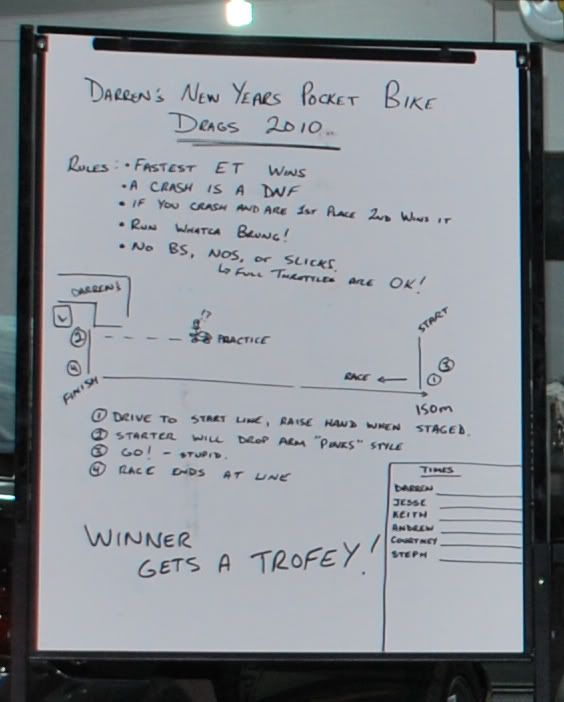
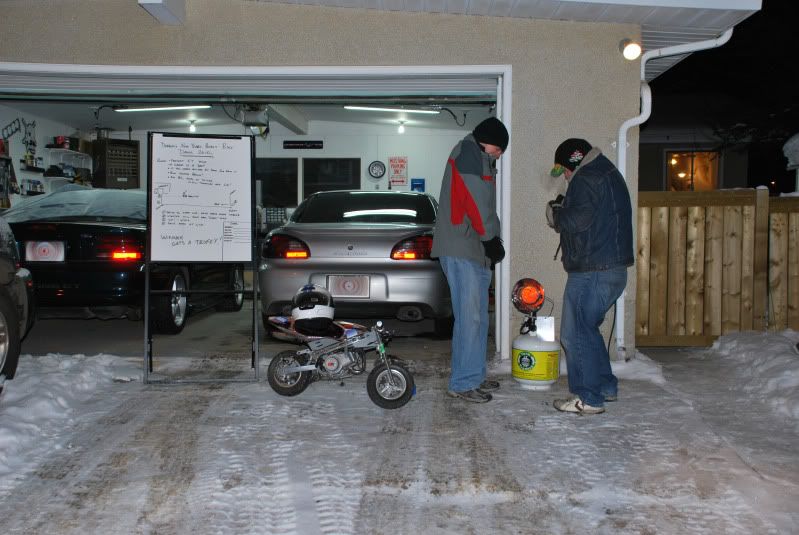
The setup was pretty good, I had rules drafted, an outdoor heater to combat the -16*C temperatures, and a darkened, ice-covered 150 meter drag strip. The rules of the event were posted on this whiteboard for any authorities that may happen to drop in as proof of what a legit series we were running.

For the record the rules were as follows:

  • Fastest ET (Elapsed Time) Wins
  • A crash is a DNF
  • Run Whatca Brung!
  • No BS, NOS, (Full Throttles are OK!) or Slicks!

Race Conduct:
    1. Drive to Start Line, (This counts as your familiarization portion) Raise Hand when staged.
    2. Starter will drop hands “Pinks” Style
    3. GO! – (stupid)
    4. Race ends at line.

Winner gets a Trofey!

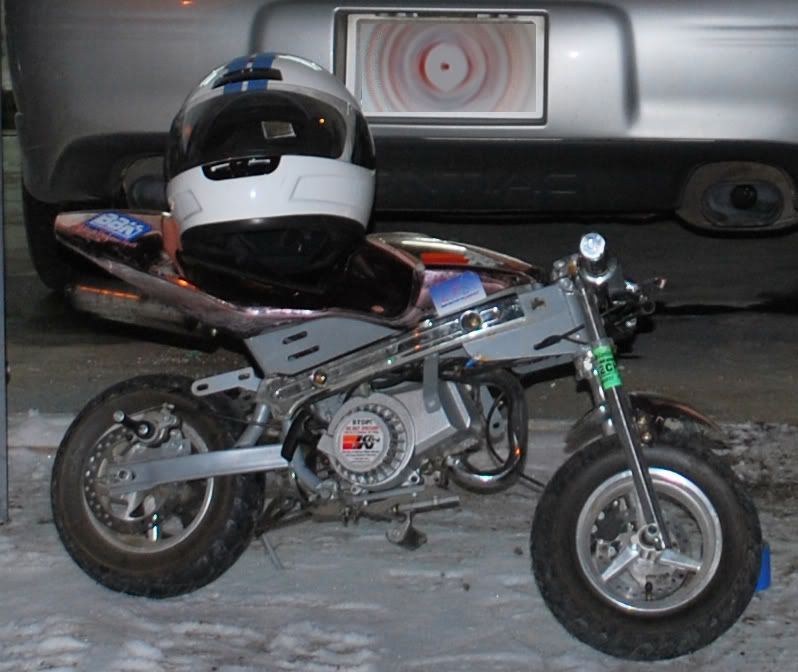
Since not everyone has a junker Chinese pocket Bike lying around we elected to use mine. This pristine, low-mileage example has seen some hard use at the hands of various riders and generally will keep on ticking.


This brought the race down to two basic items, who could manage to hold the throttle open the longest, and who was the least fat, or so we thought. The first part was made fairly tricky due to the icy conditions found in my back alley *ahem* track, and the unforeseen added an unusual challenge.

During the test & tune sessions the pocket bike performed very well, but after extended periods of idling the little 49cc 2-stroke began to grow impatient. 

Racers waiting for their turn.
 

First off we gave Hotwheels the buzzing deathtrap and he blistered across the line with an amazing run; however the timing device failed due to the cold and he had to run again. This time the reed type carburetor was having fits and he limped it through the traps with a 35.0 second pass and average speed of 15.44 km/h.

Next up was A_Gorman, our resident Pocket Bike Noob, who continually tossed the chain, stalled out, or ate snow trying to bust a sweet drift on his starting run. After 6 failed attempts, was relegated to the back of the running order before he smashed the bike completely.

At this time the girls became bored with the repair sessions and retired from the event for refreshments indoors, leaving us to hoon about in the cold.

Following the haphazard hijinks of Gorman, Landyacht made his attempts, dealing with a stall-out just off the line, he managed a quick re-stage but was hampered by frosted over eyewear. Boldly completing the run as a near-blind man Landyacht racked up a 31.5 second pass at 17.14 km/h.

I hopped on and clicked off a Stig-esque exhibition run, having the most ride-time it would be unfitting for me to win my own event, so before setting off I agreed that my time wouldn’t count in the competition.

My pass was easy, once I found the sweet-spot in the throttle to keep the ripping 1 cylinder from flooding out. A better cold weather tune-up would certainly have helped all racers, but my front tire hit the traps with a 24.0 second pass and 22.5 km/h average.

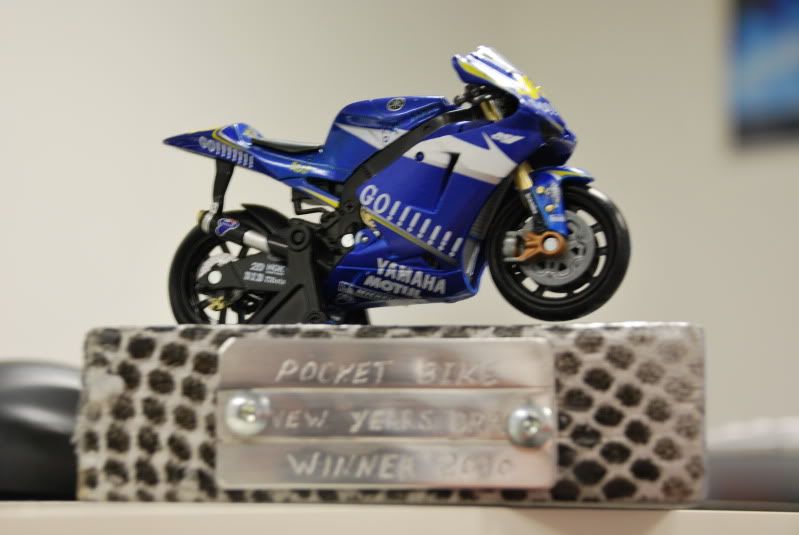
Finally it came time to give Captain smash-the-bike his retry, for the hell of it I told him about the throttle secret and wanted to see what he could do. A_Gorman made a nearly flawless pass of 25.5 seconds which netted a 21.17 km/h speed average. This final run netted Gorman the victory and seen him awarded the sweet trophy.


Hotwheels has sworn to take the next event, as his untimed pass would have made Gorman look like he was sitting still. Stay tuned as the next special event will likely occur Canada Day, by which time I will have found some more junk to fashion into a trophy.

Final standings of the 150m New Years Drag Race 2010:
  1. Darren5.0L - 24.0 seconds at 22.50 km/h
  2. A_Gorman – 25.5 seconds at 21.17 km/h
  3. Landyacht – 31.5 seconds at 17.14 km/h (Blind)
  4. Hotwheels – 35.0 seconds at 15.44 km/h (Hard Luck Award)

Sunday, December 19, 2010

Winter Driving a High Performance Vehicle

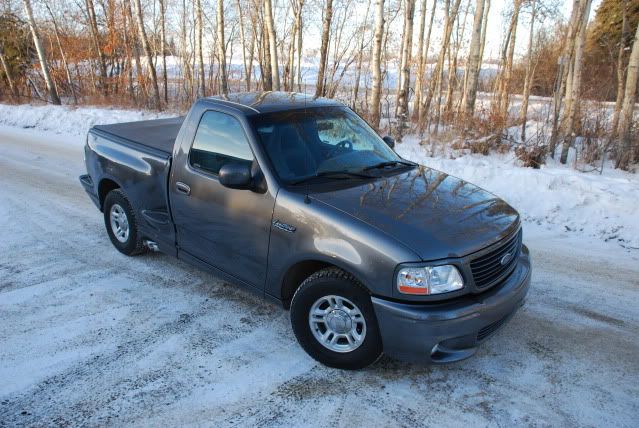
Darren5.0L's 2003 SVT Lightning in winter trim.
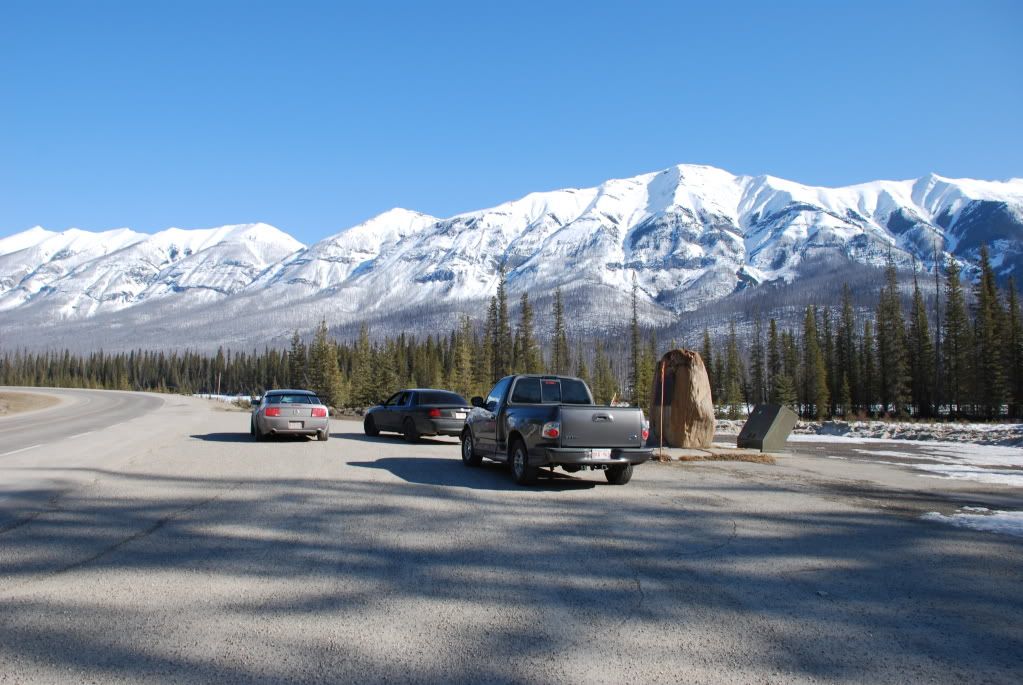
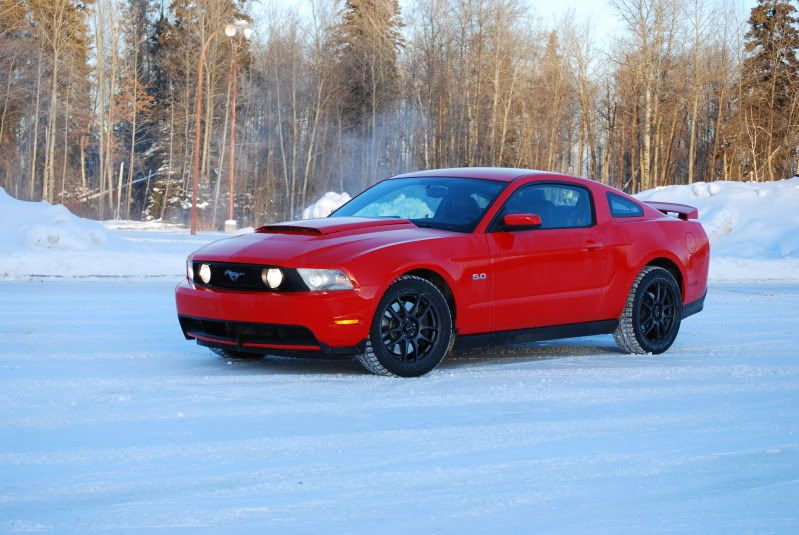
“How to you drive THAT in the winter?” Is a question I, and many of my friends are frequently asked. In the case of me, it’s a modified 2003 SVT Lightning pickup truck with over 400 horsepower at the flywheel, in the case of my friends one of them is a 500+ BHP Mercury Marauder, two of them run brand new 2011 Ford Mustang GT 5.0L, another employs his 1995 Ford Mustang GT, and finally one with a Dodge SRT-8 Magnum.

None of us have made huge investments in new body panels over the last number of years nor have we made a habit of crashing about in our performance vehicles. In fact none of this should be a big thing to boast about.

L to R: 2006 Mustang GT, 2003 Supercharged Mercury Marauder, 2003 SVT Lightning
The reason that this isn’t a big deal, is because high performance cars are just like any other car when it comes down to basic pieces, except they have “all that horsepower”. A common misconception is that a performance vehicle comes equipped with an ON/OFF switch in place of a throttle, either you are at idle, or shredding snow & ice with hundreds of horsepower. This is not the case, any performance vehicle can have the engines output to the tires modulated by using the throttle, and in many cars the light throttle condition produces surprisingly small amounts of easily manageable power.

Proper equipment is an often overlooked component to winter driving in any vehicle, but is especially important should you choose to run a performance car. Performance cars come equipped with performance tires, almost always suited specifically for warm weather wet & dry traction, by contrast this makes them completely unsuited for winter operations.

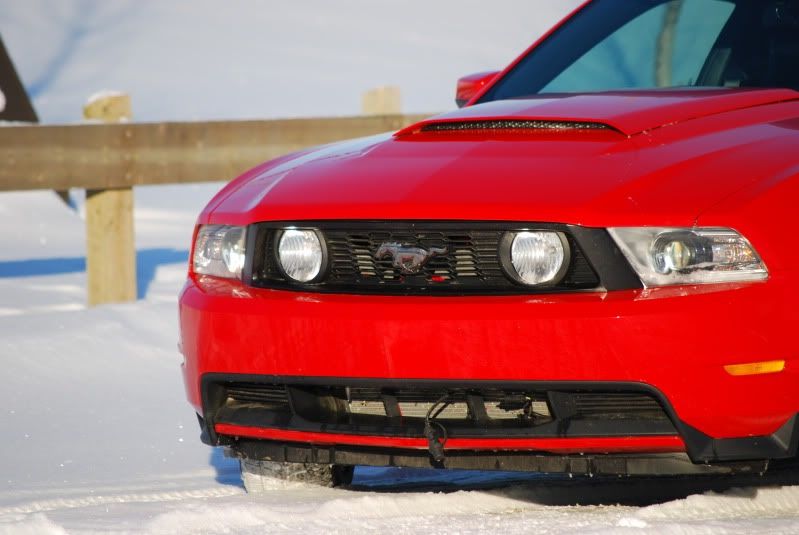
A_Gorman's 2011 Mustang GT 5.0L
You may find your vehicle comes with a tire warning sticker or section of the manual that recommends against winter operation of the factory equipped tires. The solution is simply to purchase and install a dedicated winter tire. A second set of wheels can easily be found and used exclusively as the winter set to avoid hassles.

In a rear wheel drive application some vehicles will tend to feel a little “light” in the back end. This can be easily remedied with the installation of ballast such as sandbags until your preferred handling characteristics are achieved.

Performance cars, once suitably equipped, are surprisingly easy to drive and handle in winter conditions. They will be as capable as nearly any other non-4X4 on the roads and in many cases will feature many advanced driver aids to ease your trip. Traction control, Anti-lock brakes, and Stability management are quite refined presently and can make for a very tame journey through winter conditions.

Most people who have tried winter driving with a performance vehicle and given up have often never bothered to properly equip their car, subsequently the failed experiment is usually blamed upon the capabilities of it.

In closing, it can be done, and it isn’t that big of a deal.