As compiled from online sources & magazine tests. (Updated 16 Jan 2013)
Fastest to Slowest
11 Second Range
2013 Ford Mustang Shelby GT500 - 11.25 @ 127.9 MPH (SVTP Forum)
2010 Ford Mustang Shelby GT500 - 11.951 (MM&FF Oct '09)
12 Second Range
2011 Ford Mustang Shelby GT500 - 12.0 (MM&FF Oct '10)
2007 Ford Mustang Shelby GT500 – 12.257 (MM&FF Aug '06)
2011 Ford Mustang Boss 302 - 12.3
2011 Ford Mustang Shelby GT500 - 12.35
2003 Ford Mustang SVT Cobra - 12.4
2008 Ford Mustang Roush 427R (Auto) - 12.44 (MM&FF May '08)
2006 Ford Mustang Roush Stage 3 -12.63 (MM&FF Nov '10)
2011 Ford Mustang GT - 12.67 (Dragtimes)
2003 Ford Mustang Roush Stage 3 - 12.67 (MM&FF Apr '03)
2005 Saleen SC281 - 12.676 (Dragtimes)
2011 Ford Mustang GT (Auto) - 12.73 (Dragtimes)
2000 Ford Mustang SVT Cobra R - 12.88 (Dragtimes)
2001 Ford Mustang Roush Stage 3 - 12.9
2007 Ford Mustang Shelby GT500 Convertible - 12.9
13 Second Range
2010 Ford Mustang Roush 427R - 13.1
2003 Ford Mustang Mach 1 (5 Speed) - 13.15 (MM&FF Oct '03)
2001 Ford Mustang SVT Cobra - 13.34 (MM&FF Sep '01)
2005 Mustang GT – Manual – 13.5
2010 Mustang GT - 13.5
1969 Ford Mustang Boss 429 - 13.6
2007 Ford Mustang Shelby GT - 13.6
1995 Ford Mustang SVT Cobra R - 13.67
2008 Ford Mustang Bullitt - 13.7
2011 Ford Mustang 3.7L V6 – 13.7
1971 Ford Mustang Boss 351 - 13.8
2005 Ford Mustang GT Convertible - 13.8
1969 Ford Mustang Shelby GT500 - 13.87
2003 Ford Mustang Mach 1 (Auto) - 13.88
1969 Ford Mustang Mach 1 - 13.9
1999 Ford Mustang SVT Cobra - 13.9
2007 Ford Mustang Shelby GT-H - 13.9
14 Second Range
1994 Ford Mustang SVT Cobra - 14.0
1996 Ford Mustang SVT Cobra - 14.0
1998 Ford Mustang SVT Cobra - 14.0
2001 Ford Mustang Bullitt GT - 14.1
1999 Ford Mustang GT - 14.1
1987 Ford Mustang GT - 14.4
1993 Ford Mustang SVT Cobra - 14.5
1989 Ford Mustang GT - 14.8
1992 Ford Mustang LX 5.0 - 14.8
1970 Ford Mustang Boss 302 - 14.9
1985 Ford Mustang GT - 14.9
1990 Ford Mustang LX 5.0 - 14.9
1994 Ford Mustang GT - 14.9
15 Second Range
1988 Ford Mustang GT - 15.0
1998 Ford Mustang GT - 15.04 (Dragtimes)
2005 Ford Mustang V6 - 15.3
1967 Ford Mustang (390ci V8 w/4spd) - 15.6
1991 Ford Mustang GT - 15.6
1964 Ford Mustang (289ci V8 w/4spd) - 15.7
1984 Ford Mustang SVO - 15.8
16 Second Range
1993 Ford Mustang GT (auto) - 16.1
1973 Ford Mustang 351ci - 16.3
1999 Ford Mustang Convertible V6 - 16.5
17 Second Range
1981 Ford Mustang M81 McLaren (2.3L Turbo) - 17.3
1995 Ford Mustang V6 - 17.3
1975 Ford Mustang II (302ci V8 Auto) - 17.5
1977 Ford Mustang II 302ci - 17.7
1966 Ford Mustang (289ci Auto) - 17.9
18 Second Range
1980 Ford Mustang Cobra (255ci) - 18.4
1980 Ford Mustang (255ci) - 18.5
1974 Ford Mustang II 4sp - 18.8
19 Second Range
1974 Ford Mustang II 2.3L Auto - 19.4
Know of a faster time? Link it in the comments section and I'll post it in.
Showing posts with label drag. Show all posts
Showing posts with label drag. Show all posts
Friday, April 15, 2011


Saturday, January 1, 2011
Darren’s New Years Pocket Bike Drags 2010 Race Results
Something that may become a bit of a tradition around my home is perhaps the most moronic of party games; Pocket Bike Drag Racing. It’s a really simple sport, you need a pocket bike, a drag strip, some improvised safety equipment, and a handful of foolish drivers.
This year at the inaugural event we fought various breakdowns, crashes, and cold weather to make 4 somewhat clean passes.
The setup was pretty good, I had rules drafted, an outdoor heater to combat the -16*C temperatures, and a darkened, ice-covered 150 meter drag strip. The rules of the event were posted on this whiteboard for any authorities that may happen to drop in as proof of what a legit series we were running.
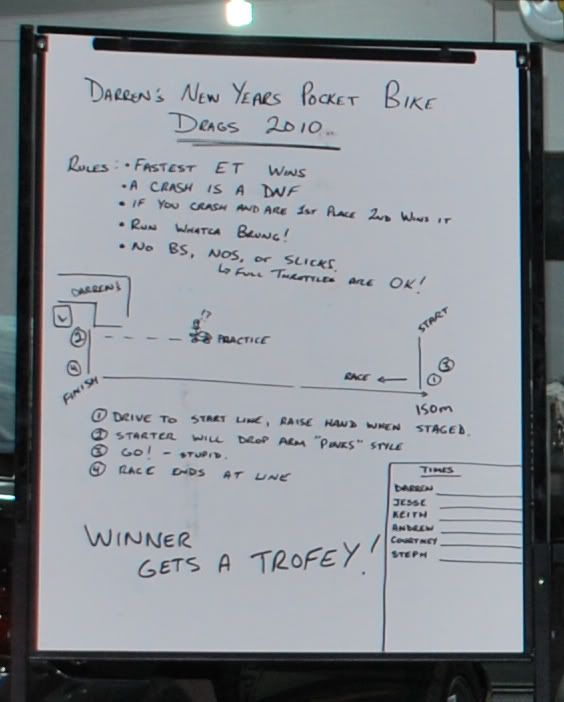
For the record the rules were as follows:
- Fastest ET (Elapsed Time) Wins
- A crash is a DNF
- Run Whatca Brung!
- No BS, NOS, (Full Throttles are OK!) or Slicks!
Race Conduct:
- Drive to Start Line, (This counts as your familiarization portion) Raise Hand when staged.
- Starter will drop hands “Pinks” Style
- GO! – (stupid)
- Race ends at line.
Winner gets a Trofey!
Since not everyone has a junker Chinese pocket Bike lying around we elected to use mine. This pristine, low-mileage example has seen some hard use at the hands of various riders and generally will keep on ticking.
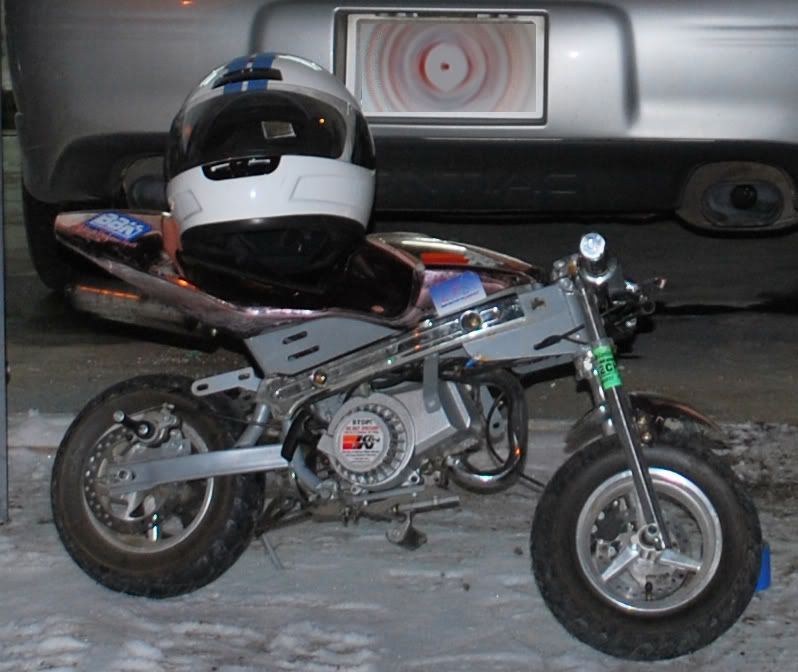
This brought the race down to two basic items, who could manage to hold the throttle open the longest, and who was the least fat, or so we thought. The first part was made fairly tricky due to the icy conditions found in my back alley *ahem* track, and the unforeseen added an unusual challenge.
During the test & tune sessions the pocket bike performed very well, but after extended periods of idling the little 49cc 2-stroke began to grow impatient.
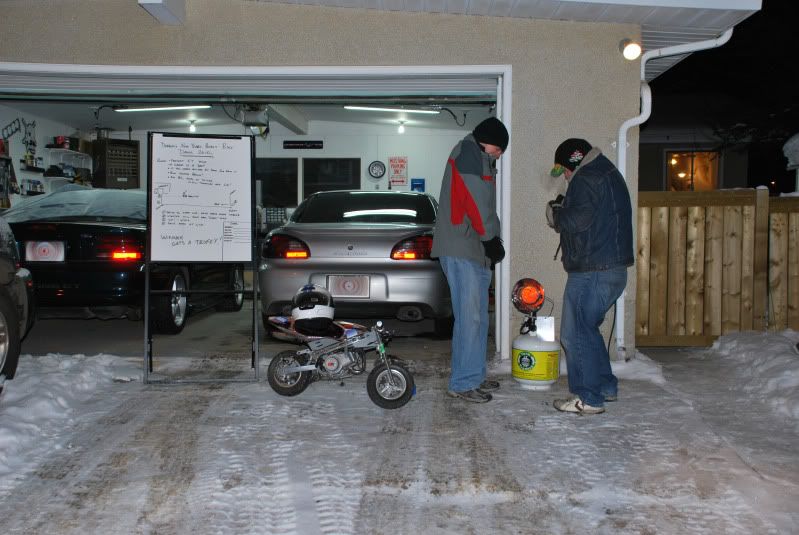 |
| Racers waiting for their turn. |
First off we gave Hotwheels the buzzing deathtrap and he blistered across the line with an amazing run; however the timing device failed due to the cold and he had to run again. This time the reed type carburetor was having fits and he limped it through the traps with a 35.0 second pass and average speed of 15.44 km/h.
Next up was A_Gorman, our resident Pocket Bike Noob, who continually tossed the chain, stalled out, or ate snow trying to bust a sweet drift on his starting run. After 6 failed attempts, was relegated to the back of the running order before he smashed the bike completely.
At this time the girls became bored with the repair sessions and retired from the event for refreshments indoors, leaving us to hoon about in the cold.
Following the haphazard hijinks of Gorman, Landyacht made his attempts, dealing with a stall-out just off the line, he managed a quick re-stage but was hampered by frosted over eyewear. Boldly completing the run as a near-blind man Landyacht racked up a 31.5 second pass at 17.14 km/h.
I hopped on and clicked off a Stig-esque exhibition run, having the most ride-time it would be unfitting for me to win my own event, so before setting off I agreed that my time wouldn’t count in the competition.
My pass was easy, once I found the sweet-spot in the throttle to keep the ripping 1 cylinder from flooding out. A better cold weather tune-up would certainly have helped all racers, but my front tire hit the traps with a 24.0 second pass and 22.5 km/h average.
Finally it came time to give Captain smash-the-bike his retry, for the hell of it I told him about the throttle secret and wanted to see what he could do. A_Gorman made a nearly flawless pass of 25.5 seconds which netted a 21.17 km/h speed average. This final run netted Gorman the victory and seen him awarded the sweet trophy.
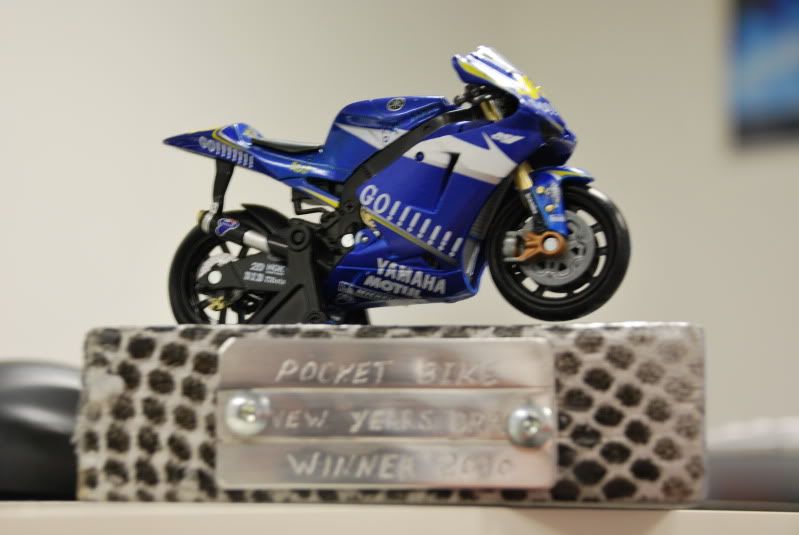
Hotwheels has sworn to take the next event, as his untimed pass would have made Gorman look like he was sitting still. Stay tuned as the next special event will likely occur Canada Day, by which time I will have found some more junk to fashion into a trophy.
Final standings of the 150m New Years Drag Race 2010:
- Darren5.0L - 24.0 seconds at 22.50 km/h
- A_Gorman – 25.5 seconds at 21.17 km/h
- Landyacht – 31.5 seconds at 17.14 km/h (Blind)
- Hotwheels – 35.0 seconds at 15.44 km/h (Hard Luck Award)
Saturday, October 30, 2010
Modern Performance Vehicles's K-Spec Drag Racing Program
08-26-2009
It’s green, it ain’t mean, it isn’t much to look at, and it certainly isn’t worth writing home about, but we’re doing it anyway. How’s that for an introduction to Modern Performance Vehicle’s idea for a silly project?
Behold Hotwheel’s kind donation to the MPV Kijiji Spec (That’s K-Spec!) drag program:
I suppose donation is the wrong term, something like “willing to go along with” or “be party to” works better. Anyway, Ford Motor Company’s wildly popular Tempo just got… …noticed again. Keeping in line with Hotwheel’s mantra of no matter how unsuitable, take everything down the strip, and Grand Touring Concept’s of anything can be hot-rodded, we bring you the K-SPEC drag program.
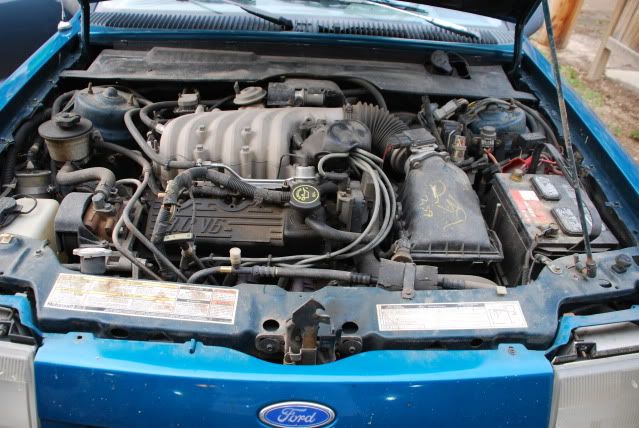
Taking a select (AKA running) example of the Ford Tempo, we obtained the fastest, most modern version, the top of the range, 1994 Tempo GL. We ensured it was equipped with nothing less than the potent (for a Tempo) 3.0L Vulcan V6, the consistent FLC-ATX 3-speed automatic transmission, 2 doors for lower curb weight, and just broken-in 280,000km mileage for peak potential. This car was sure to be a contender in this one-horse race.
Actually the entire thing above is total BS, Jesse had it lying around and we thought we’d try to drag it, and then (try to) make it faster. Footnote: (Without actually spending *any* money)
Before making something faster you have to establish a baseline, and on 8:05 PM, Car Number 4023 made it’s first of 5 passes at Edmonton’s Castrol Raceway Park.
Hotwheels narrowed his eyes against to low setting sun, and prepared for what likely wouldn’t be one hell of a pass. The lights dropped and stomping the mild whirring noise pedal, he cut a .240 reaction time, the sixty foot was gone in a scant 2.833 seconds. With no hint of burning oil or coolant he eventually crossed the traps with a 18.188 @ 76.07 MPH. K-Spec drag racing, a much better past time to waiting in a doctor’s office, rather we had our baseline.
With his trademark enthusiasm, Jesse figured he could do better with colder air, so we waited a little and he made 4 more passes. The second last run was a surprising improvement to 17.618 @ 77.77 MPH, low 12’s were going to be easy! We’d already dropped over half a second and picked up 1.7 miles per hour with only telling Jesse to drive faster. Once we started modding the times should simply drop like the resale value of a Pontiac product, oh I did just go there…
Let’s talk horsepower here, you know real stuff. Fresh from the factory our updated Vulcan engine, with it’s reduced friction pistons, a strengthened block, roller camshaft and other changes, thumped out 141 Horsepower and 160 ft-lbs of Torque. This seasoned example was surely putting out more than the “detuned” factory trim so we had to see what we were working with.
To figure our horsepower out for certain, naturally the next step was to, you guessed it, the internet. (Who said dyno? Those things cost money!)
So, using the online ¼ mile drag calculator java program we can get some cheap-as-free results.
The drag calculator over at Dragtimes assured Flywheel horsepower rating or our money back, but we had to supply the numbers.
Quarter Mile times were 18.188 and 17.618.
Trap Speed supplied from the timeslips were 76.07 and 77.77MPH.
Let’s see, the infalliable wikipedia says that a Ford Tempo has a curb weight 2723 lb (1235 kg) and our Driver might weigh 175 lbs for a total of 2898 lbs
With the numbers ready, the computer internet dyno began to spool up and everyone in the internet dyno cell was deafened as the display spat out our results:
Run #1 = 97.38 HP @ Flywheel
Run #2 = 105.57 HP @ Flywheel
Clearly the internet dyno must load heavier than a MD-600, but we can at least see the difference mod for mod, provided we always use the same internet dyno. Summarizing above, you can plainly see that telling Jesse to drive faster resulted in a whopping increase of 8.19 horsepower over stock, that friends, is massive.
Satisfied that we had a built on a Wednesday ringer, we planned for the next session.
Part 2:
09-03-2009
Back at the Grand Touring Concepts R&D facility (actually Darren’s garage which may have an adjustable wrench and a hammer) MPV 's goons set to work on extracting more horsepower from the wild Tempo.

Using some spare parts Hotwheel's has amassed, we set to work with a grinder mounted flapwheel to build a better inlet assembly. A high performance (junkyard) MAF was carefully milled (locked in a bench vise and attacked with a grinder) to accept a proven (again used) K&N conical Airfilter, we had specially chosen (of the 3 we had in a box) for this car. We retained the bottom part of the airbox assembly to act as a heat shield against the awesome under hood temps.
Grand Touring Concepts is kind of new to the FWD game but we understand this arrangement is called a "short-ram" intake, I guess it sounds better than exposed hot Air conical filter to folks not in the know. If my Dentist office reading of popular sport compact magazines indicated anything, we should behold outstanding gains from this modification.
So there it is; the GTC Exposed Short-Ram Conical Intake System (ESRCI) PN#X30V6 not on sale near you. Look for our booth at SEMA 2011.
As with all performance parts that "claim" to "add" horsepower, we needed to prove this part before K-spec marketing can ever begin. With that we're back to the strip...
On 7 August, Hotwheels was set to deliver a faster time with the newfound power provided by the experimental Grand Touring Concepts ESCRI. The K-spec Tempo made a grueling 7 passes, battling hot air temperatures to finalize gains made with the ESCRI. At 10:21pm a 17.640 @ 78.13 MPH was posted, followed by a 17.634 @ 78.17 MPH twenty minutes later. Late in the evening at 10:51 pm we had our best run; 17.607 @ 78.05 MPH, the ESRCI was a success, production can start immediately!
ESRCI Testing runs, available in HD:
http://www.youtube.com/watch?v=kjSpvMZgF40
Working on our promotional material we needed to visit the online dyno with our new results so our HP gains could be advertised with the product.
Using the same weight number as the last test, (we are very certain that Jesse did not starve himself for the sake of going faster) we awaited the results…
The best run worked out to 106.4 HP at the flywheel with the other 3 posted runs supporting the findings.
ESCRI 106.4 HP minus Stock 97.38 HP equals 9.02 BHP, which is nearly a solid 10 horsepower gain. This modification system is clearly worth more than the $300 USD plus shipping that our PR department plans on charging.
Here are our performance tables so far:
Stock (Booo!)
97.38 BHP - 18.188 @ 76.07 MPH
Waiting for cooler air (Super Tuning)
105.57 BHP - 17.618 @ 77.77 MPH
Super Tuning + GTC ESCRI (Super Awesome, tell your friends)
106.40 HP - 17.607 @ 78.05 MPH
Disclaimer:
(Actual testing of ESRCI with Super tuning versus Stock with Super tuning may result in a net gain of only 0.83 Horsepower…)
With these awesome successes, we know we have to keep pushing forward in order to keep ahead of the currently non-existent (and likely never existent) competition.
Setting the bar a notch higher, we'll see you next time.
It’s green, it ain’t mean, it isn’t much to look at, and it certainly isn’t worth writing home about, but we’re doing it anyway. How’s that for an introduction to Modern Performance Vehicle’s idea for a silly project?
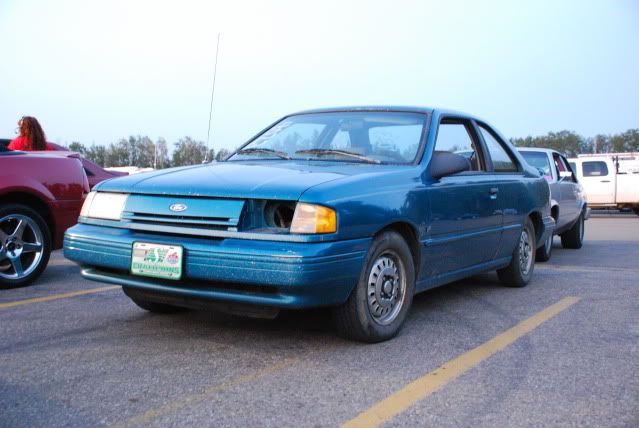
Behold Hotwheel’s kind donation to the MPV Kijiji Spec (That’s K-Spec!) drag program:
| |||
| Shown with optional headlight delete |
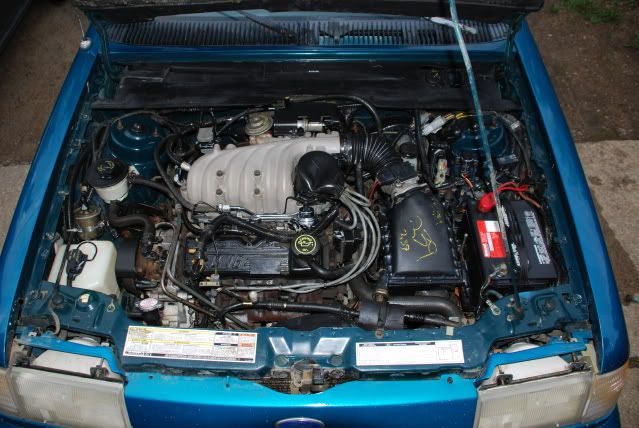
Taking a select (AKA running) example of the Ford Tempo, we obtained the fastest, most modern version, the top of the range, 1994 Tempo GL. We ensured it was equipped with nothing less than the potent (for a Tempo) 3.0L Vulcan V6, the consistent FLC-ATX 3-speed automatic transmission, 2 doors for lower curb weight, and just broken-in 280,000km mileage for peak potential. This car was sure to be a contender in this one-horse race.
 |
| The holy grail of Tempo performance, 3.0L V6! |
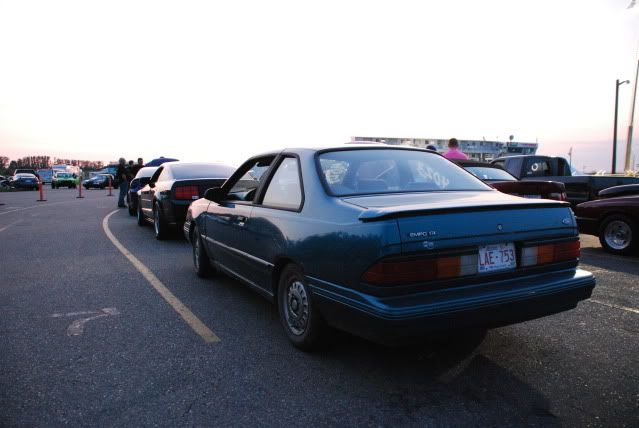
Before making something faster you have to establish a baseline, and on 8:05 PM, Car Number 4023 made it’s first of 5 passes at Edmonton’s Castrol Raceway Park.
 |
| Coiled and ready to... um what is it Tempos do? ... Maintain a steady beat? |
With his trademark enthusiasm, Jesse figured he could do better with colder air, so we waited a little and he made 4 more passes. The second last run was a surprising improvement to 17.618 @ 77.77 MPH, low 12’s were going to be easy! We’d already dropped over half a second and picked up 1.7 miles per hour with only telling Jesse to drive faster. Once we started modding the times should simply drop like the resale value of a Pontiac product, oh I did just go there…
Let’s talk horsepower here, you know real stuff. Fresh from the factory our updated Vulcan engine, with it’s reduced friction pistons, a strengthened block, roller camshaft and other changes, thumped out 141 Horsepower and 160 ft-lbs of Torque. This seasoned example was surely putting out more than the “detuned” factory trim so we had to see what we were working with.
To figure our horsepower out for certain, naturally the next step was to, you guessed it, the internet. (Who said dyno? Those things cost money!)
So, using the online ¼ mile drag calculator java program we can get some cheap-as-free results.
The drag calculator over at Dragtimes assured Flywheel horsepower rating or our money back, but we had to supply the numbers.
Quarter Mile times were 18.188 and 17.618.
Trap Speed supplied from the timeslips were 76.07 and 77.77MPH.
Let’s see, the infalliable wikipedia says that a Ford Tempo has a curb weight 2723 lb (1235 kg) and our Driver might weigh 175 lbs for a total of 2898 lbs
 |
| We also washed it to lower parasitic loss due to heat retention |
With the numbers ready, the computer internet dyno began to spool up and everyone in the internet dyno cell was deafened as the display spat out our results:
Run #1 = 97.38 HP @ Flywheel
Run #2 = 105.57 HP @ Flywheel
Clearly the internet dyno must load heavier than a MD-600, but we can at least see the difference mod for mod, provided we always use the same internet dyno. Summarizing above, you can plainly see that telling Jesse to drive faster resulted in a whopping increase of 8.19 horsepower over stock, that friends, is massive.
Satisfied that we had a built on a Wednesday ringer, we planned for the next session.
Part 2:
09-03-2009
Back at the Grand Touring Concepts R&D facility (actually Darren’s garage which may have an adjustable wrench and a hammer) MPV 's goons set to work on extracting more horsepower from the wild Tempo.
Using some spare parts Hotwheel's has amassed, we set to work with a grinder mounted flapwheel to build a better inlet assembly. A high performance (junkyard) MAF was carefully milled (locked in a bench vise and attacked with a grinder) to accept a proven (again used) K&N conical Airfilter, we had specially chosen (of the 3 we had in a box) for this car. We retained the bottom part of the airbox assembly to act as a heat shield against the awesome under hood temps.
Grand Touring Concepts is kind of new to the FWD game but we understand this arrangement is called a "short-ram" intake, I guess it sounds better than exposed hot Air conical filter to folks not in the know. If my Dentist office reading of popular sport compact magazines indicated anything, we should behold outstanding gains from this modification.
So there it is; the GTC Exposed Short-Ram Conical Intake System (ESRCI) PN#X30V6 not on sale near you. Look for our booth at SEMA 2011.
 |
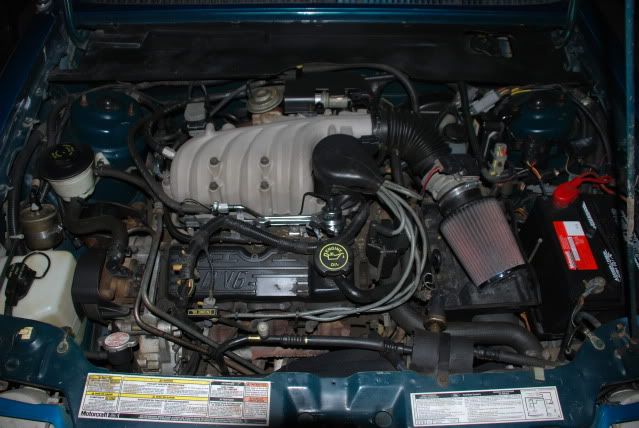
On 7 August, Hotwheels was set to deliver a faster time with the newfound power provided by the experimental Grand Touring Concepts ESCRI. The K-spec Tempo made a grueling 7 passes, battling hot air temperatures to finalize gains made with the ESCRI. At 10:21pm a 17.640 @ 78.13 MPH was posted, followed by a 17.634 @ 78.17 MPH twenty minutes later. Late in the evening at 10:51 pm we had our best run; 17.607 @ 78.05 MPH, the ESRCI was a success, production can start immediately!
ESRCI Testing runs, available in HD:
http://www.youtube.com/watch?v=kjSpvMZgF40
Working on our promotional material we needed to visit the online dyno with our new results so our HP gains could be advertised with the product.
Using the same weight number as the last test, (we are very certain that Jesse did not starve himself for the sake of going faster) we awaited the results…
The best run worked out to 106.4 HP at the flywheel with the other 3 posted runs supporting the findings.
ESCRI 106.4 HP minus Stock 97.38 HP equals 9.02 BHP, which is nearly a solid 10 horsepower gain. This modification system is clearly worth more than the $300 USD plus shipping that our PR department plans on charging.
Here are our performance tables so far:
Stock (Booo!)
97.38 BHP - 18.188 @ 76.07 MPH
Waiting for cooler air (Super Tuning)
105.57 BHP - 17.618 @ 77.77 MPH
Super Tuning + GTC ESCRI (Super Awesome, tell your friends)
106.40 HP - 17.607 @ 78.05 MPH
Disclaimer:
(Actual testing of ESRCI with Super tuning versus Stock with Super tuning may result in a net gain of only 0.83 Horsepower…)
With these awesome successes, we know we have to keep pushing forward in order to keep ahead of the currently non-existent (and likely never existent) competition.
Setting the bar a notch higher, we'll see you next time.
Subscribe to:
Posts (Atom)